
If a headline this week told you power prices fell nationally, it was wrong in a way that matters for your own bill. Australia has no national retail electricity price. What reset on 1 July 2026 was a collection of separate benchmark and regulated prices, each set by a different body, each covering different households, and they did not all move the same way.
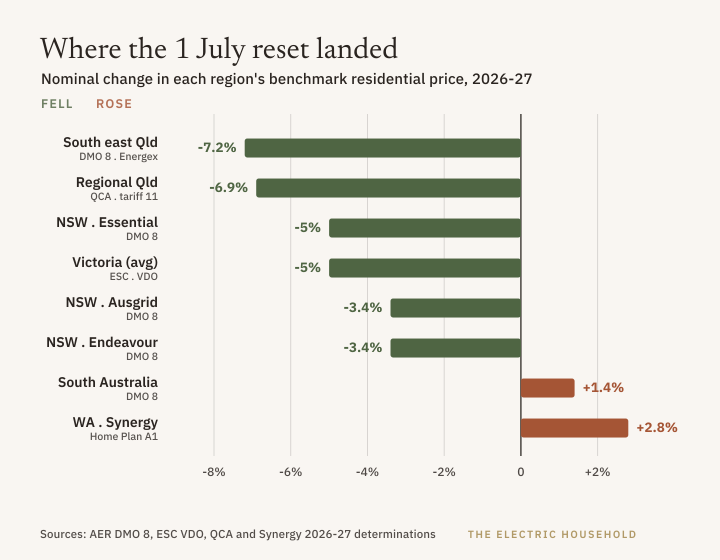
Nominal year-on-year change in each region's benchmark or regulated residential flat-rate price, as set by its own instrument: the AER Default Market Offer (NSW, SEQ, SA), the ESC Victorian Default Offer (Victorian average across five zones), the QCA notified price, tariff 11 (regional Queensland), and Synergy's government-set Home Plan A1 usage rate (WA, computed from the published 2025 and 2026 rates). Each source states its own annual usage assumption; sources below.
Download a one-page reference (PDF): the chart, every region's reference bill and the four determinations it draws on, on one printable page and free to share with attribution.
NSW, south east Queensland and SA: the Default Market Offer
The Australian Energy Regulator's Default Market Offer final determination (DMO 8, published 26 May 2026) sets the maximum standing-offer price for NSW, south east Queensland and South Australia from 1 July. It is a safety-net price, not the price most households pay: if you are on a market offer, your own contract moved on its own schedule. The new annual reference bills for a flat-rate residential customer, at the usage the AER itself assumes:
DMO 8 reference bills, residential flat rate, from 1 July 2026
| Network region | Annual bill | Assumed usage | Change | Change (real) |
|---|---|---|---|---|
| Ausgrid (Sydney, Central Coast, Hunter) | $1,899 | 3,900 kWh | −$66 (−3.4%) | −8.2% |
| Endeavour Energy (western Sydney, Illawarra) | $2,328 | 4,900 kWh | −$83 (−3.4%) | −8.2% |
| Essential Energy (regional NSW) | $2,604 | 4,600 kWh | −$137 (−5.0%) | −9.8% |
| Energex (south east Queensland) | $1,988 | 4,600 kWh | −$155 (−7.2%) | −12.0% |
| SA Power Networks (South Australia) | $2,334 | 4,000 kWh | +$33 (+1.4%) | −3.4% |
Source: AER, DMO 2026–27 final determination, Table 2.1, prices include GST. "Real" adjusts for the RBA's 4.8 per cent 2025–26 inflation forecast (May 2026 Statement on Monetary Policy), as the AER's own table does. A household using more or less than the assumed figure will see a different dollar change.
South Australia is the one DMO region where the nominal price rose. The AER's determination attributes the increase largely to elevated costs from high-priced Frequency Control Ancillary Services events in July and August 2025, network costs that flowed through to this year's price.
Victoria: a separate regulator, a separate price
Victoria is not covered by the DMO. Its equivalent, the Victorian Default Offer, is set by the Essential Services Commission under Victorian law. The 2026–27 final decision (20 May 2026) puts the average annual domestic flat-tariff bill at $1,591 on 4,000 kWh a year, down $84 or 5 per cent. The fall is not uniform across the state's five distribution zones: AusNet households see $160 (8 per cent) come off, United Energy households $50 (3 per cent).
The same decision matters even if you are on a market contract, for one reason: the ESC reports that around 512,000 Victorian households, 17 per cent, are on standing offers where the VDO is not a benchmark but their actual price, and it notes the number has been rising as retailers move customers with expired contracts onto standing offers. If you have not looked at your plan since your last contract ended, you may be one of them.
Regional Queensland: priced off someone else's benchmark
Households outside south east Queensland have neither a DMO nor a VDO. Their notified prices are set by the Queensland Competition Authority, and the QCA's 2026–27 final determination expects a typical customer on the main residential tariff (tariff 11) to pay around 6.9 per cent less. The mechanism is worth knowing: the QCA's report states the fall is largely driven by the lower default market offer for south east Queensland, which acts as a cap on what regional prices can be set at, while the state's uniform tariff policy holds country prices to city levels through a community service obligation payment. Regional Queensland's price cut is, in a real sense, Brisbane's DMO exported north and west.
WA and the NT: no DMO, no VDO, and prices went up
Western Australia has neither instrument. Most Perth and south west households are on Synergy's Home Plan (A1) tariff, set through the WA state budget process. Synergy's published 2026 price change lifts the electricity charge from 32.3719 to 33.2621 cents per unit and the daily supply charge from 116.0505 to 119.2419 cents, both increases of about 2.8 per cent, taking effect while the eastern-state benchmarks fell. Northern Territory prices are likewise set through the NT Government rather than a market regulator; we have not verified the current NT pricing order, and Territory readers should check their Jacana Energy tariff directly.
What this means for your household
Three practical points fall out of the documents. First, if you are in NSW, SEQ or SA and your bill did not fall from 1 July, you are probably on a market offer whose price is set by contract, not by the DMO; the reference bills above are the comparison point retailers must quote against. Second, the two official comparison tools are state-split: Energy Made Easy covers NSW, Queensland, SA, Tasmania and the ACT, while Victoria has its own Victorian Energy Compare. Both are government-run and free, and neither pays anyone a commission. Third, the regulated prices above are flat-rate figures; time-of-use prices reset on the same date, and in Victoria the new default offer builds in a cheap "solar soak" window from 11am to 4pm, which is the subject of its own story in the DMO states.